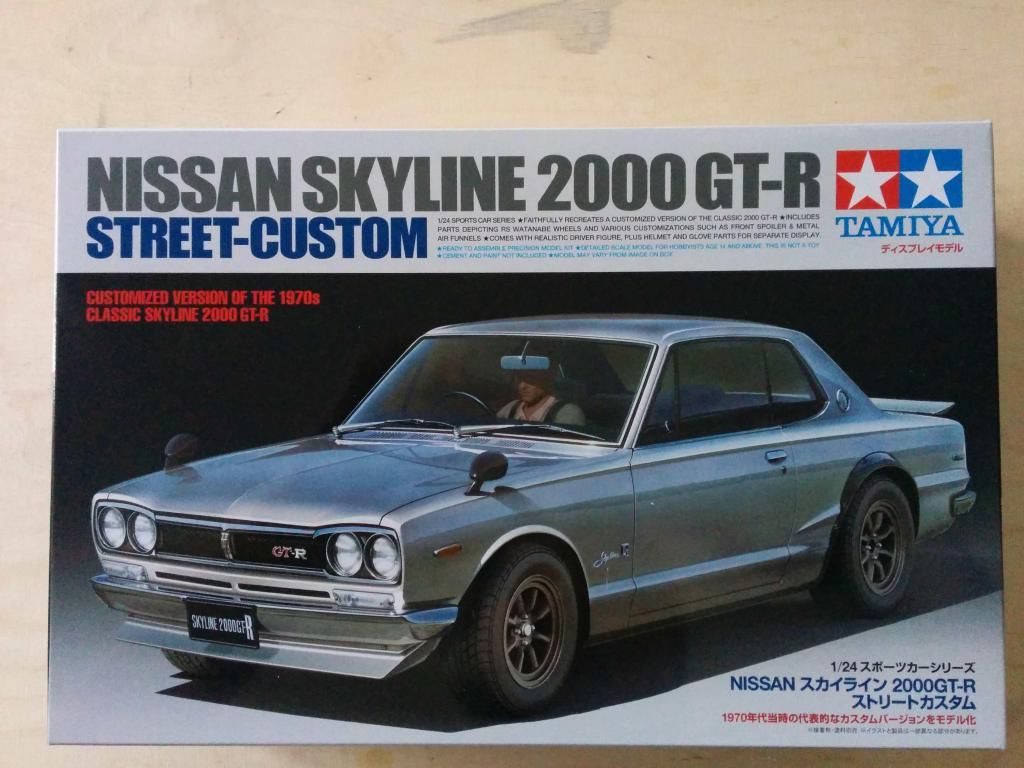
Tamiya Nissan Skyline 2000 GT-R Street Custom 1/24 [Photo]
Posted: Wed Dec 31, 2014 2:11 pm
Nissan Skyline GT-R 2000 Street Custom

Hello my fellow styrene enthusiasts,
As I threatened in the in my previous post of a recent haul from Japan, I have decided to do a kit review of the Tamiya Nissan Skyline 2000 GT-R Street Custom. Before we get into it, I wanna be clear about the fact that I have really no business writing a review for a kit. That's to say, I am in no way experienced enough to be qualified to review a kit. Nevertheless, when I first opened the box and saw all that beautiful plastic I just couldn't help myself. So here we are. The following is my first review of anything really and in particular of a model kit.
History
Before we get into it though, a brief history on the Nissan GT-R, courtesy of Wikipedia:
The Street Custom kit is a 2014 release based on the earlier 24195 kit of the Nissan GT-R 2000, as pictured above. The new release includes several custom upgrades such as extended wheel-arches in the back, custom tires, front aero kit, rear spoiler, oil-cooler and racing seat-belts
The Box:
The box is your typical Tamiya box as we have all seen plenty of I am sure. The only noticeable difference is that the PE and Metal parts are held together in a separate folder.
The Sides:

The Plastic:
First and perhaps most importantly, the body:


Now I noticed some strange lines and discoloration here. At first I thought they were cracks but lucky it doesn't appear to be so. I am not sure what caused these but as the kit will be re-sprayed anyway I am not worried about it. Aside from this, the mold is very crisp, with nice details. I noticed no imperfections, flash or other problems at all.

Up next, we have the engine bay. Again, very nice detail straight out of the box, which will be enhanced with some photo-etch. The engine is molded in the same plastic as the body and again shows signs of these strange lines, which I assume are result of mixing different colors into the plastic (correct me please if I am wrong).

Some additional detail shots:


I did notice that the underside of the bonnet did show some ejector pin marks, which need to be attended to if the kit is to be displayed with the bonnet open. Fortunately, the pin marks seem to be very shallow and should be easily removed.

On to the tires! The tires are rubber and have some very nicely detailed tread.

The chassis tub:
Not much to be said here, again detail seems to be there and no sign of flash or other imperfections.

The Chrome:
The chrome looks rather nice out of the box. I have personally not worked with chromed parts before, but I would imagine that it would be difficult to seperate from the sprue without damaging it. I think I will re-spray those with Mr. Metal Colour or perhaps even Alclad.

Decals
Unfortunately, when you buy a Tamiya kit you get Tamiya decals with it.... Just hope they dont fall to pieces on me...


The seat-belts, which look to be just stickers...

I have many more pictures of the sprues over in my photobucket, if you would like to check them out. Else, we will now move on to the instructions
The Instructions
The instructions look to be typical Tamiya, Fold out sheet in 23 steps with detailed descriptions in Japanese, German, English and French. Steps are not too crowded and fairly easy to follow.


I am not sure I fully understand the seat-belt assembly yet. It seemed to me that they were stickers ...

Colour Call-out
Colour call-outs only referencing their own range of spray and acrylics, fair enough I guess but a bit of a pain in the butt if I am honest.


Conclusion
It's a Tamiya kit. - there is really not much else to say. We all, I think, know the strengths of their kits and their weaknesses ( looking at you decals!). I expect the fit will be great, as we have seen there is no flash or imperfections which could be problematic. The presentation of the box is amazing, which is why I felt compelled to pen this review in the first place. I can't wait to get my glue stained fingers on this puppy! 
What I like about road cars is that I can ultimately do whatever I want with it. Paint it pink? Why the hell not? I am sure there is one or two pink GT-Rs cruising around the streets of Tokyo. I probably wont paint it pink but I will most likely deviate from the suggested paint scheme. I am thinking flat black maybe... We will see.
So there it is. My first ever review. If you managed to stick around to this point, THANKS for reading. I hope it was at least a little informative. I hope to do more of these in the future, if people are interested. I think I may have one or two kits in the stash which have not yet been reviewed here.
Cheers,

Hello my fellow styrene enthusiasts,
As I threatened in the in my previous post of a recent haul from Japan, I have decided to do a kit review of the Tamiya Nissan Skyline 2000 GT-R Street Custom. Before we get into it, I wanna be clear about the fact that I have really no business writing a review for a kit. That's to say, I am in no way experienced enough to be qualified to review a kit. Nevertheless, when I first opened the box and saw all that beautiful plastic I just couldn't help myself. So here we are. The following is my first review of anything really and in particular of a model kit.
History
Before we get into it though, a brief history on the Nissan GT-R, courtesy of Wikipedia:
The KitThe Nissan Skyline GT-R is a Japanese grand tourer based on the Nissan Skyline range.
The first GT-Rs were produced from 1969–1973. After a 16 year hiatus since the KPGC110 in 1972, the GT-R name was revived in 1989 with the Skyline R32. This car was nicknamed "Godzilla" by the Australian motoring publication Wheels in its July 1989 edition. The BNR32 (R32 GT-R) would end up winning 29 straight victories out of 29 races in the Japanese motorsport. The GT-R proceeded to win the JTCC Group A series championship 4 years in a row, and also had success in the Australian Touring Car Championship winning from 1990–1992, until a regulation change excluded the GT-R in 1993.[1]
The Skyline GT-R became the flagship of Nissan performance,and showcasing many advanced technologies including the ATTESA E-TS 4WD system and the Super-HICAS four-wheel steering. The GT-Rs remained inexpensive compared to its European rivals, with a list-price of ¥4,500,000 (US$31,000)[citation needed]. Today, the car is popular for import drag racing, circuit track, time attack and events hosted by tuning magazines. The GT-R is the winner in the 2007 Tsukuba Time Attack held in Japan—the M-Speed GT-R (9 out of the top 15 cars consists of GT-Rs). Production of the Skyline GT-R ended in August 2002. The car was replaced by the Nissan GT-R, an independent vehicle not sold as a Skyline.
The Skyline GT-R was never manufactured outside of Japan, and the sole export markets were Hong Kong, Australia and New Zealand, in 1991,[2] and the UK (in 1997, thanks to the Single Vehicle Approval scheme[3]) as used Japanese imports. Despite this the car has become an iconic sports car, including in countries from the Western World (mainly the United Kingdom, Australia, New Zealand, South Africa, Ireland and Canada).[4][5][6] It has become notable through pop culture such as The Fast and the Furious series, Initial D, Shakotan Boogie, Wangan Midnight, and Gran Turismo.
The car was named at the time by BBC's Top Gear as the only true Japanese contribution in the line of supercars,[7] and by Jeremy Clarkson as one of the best cars in the world.[8][9]
The Street Custom kit is a 2014 release based on the earlier 24195 kit of the Nissan GT-R 2000, as pictured above. The new release includes several custom upgrades such as extended wheel-arches in the back, custom tires, front aero kit, rear spoiler, oil-cooler and racing seat-belts
The Box:
The box is your typical Tamiya box as we have all seen plenty of I am sure. The only noticeable difference is that the PE and Metal parts are held together in a separate folder.

The Sides:

The Plastic:
First and perhaps most importantly, the body:


Now I noticed some strange lines and discoloration here. At first I thought they were cracks but lucky it doesn't appear to be so. I am not sure what caused these but as the kit will be re-sprayed anyway I am not worried about it. Aside from this, the mold is very crisp, with nice details. I noticed no imperfections, flash or other problems at all.

Up next, we have the engine bay. Again, very nice detail straight out of the box, which will be enhanced with some photo-etch. The engine is molded in the same plastic as the body and again shows signs of these strange lines, which I assume are result of mixing different colors into the plastic (correct me please if I am wrong).

Some additional detail shots:


I did notice that the underside of the bonnet did show some ejector pin marks, which need to be attended to if the kit is to be displayed with the bonnet open. Fortunately, the pin marks seem to be very shallow and should be easily removed.

On to the tires! The tires are rubber and have some very nicely detailed tread.

The chassis tub:
Not much to be said here, again detail seems to be there and no sign of flash or other imperfections.

The Chrome:
The chrome looks rather nice out of the box. I have personally not worked with chromed parts before, but I would imagine that it would be difficult to seperate from the sprue without damaging it. I think I will re-spray those with Mr. Metal Colour or perhaps even Alclad.

Decals
Unfortunately, when you buy a Tamiya kit you get Tamiya decals with it....
Just hope they dont fall to pieces on me... 

The seat-belts, which look to be just stickers...

I have many more pictures of the sprues over in my photobucket, if you would like to check them out. Else, we will now move on to the instructions
The Instructions
The instructions look to be typical Tamiya, Fold out sheet in 23 steps with detailed descriptions in Japanese, German, English and French. Steps are not too crowded and fairly easy to follow.


I am not sure I fully understand the seat-belt assembly yet. It seemed to me that they were stickers ...

Colour Call-out
Colour call-outs only referencing their own range of spray and acrylics, fair enough I guess but a bit of a pain in the butt if I am honest.


Conclusion
It's a Tamiya kit. - there is really not much else to say. We all, I think, know the strengths of their kits and their weaknesses (
looking at you decals!). I expect the fit will be great, as we have seen there is no flash or imperfections which could be problematic. The presentation of the box is amazing, which is why I felt compelled to pen this review in the first place. I can't wait to get my glue stained fingers on this puppy! What I like about road cars is that I can ultimately do whatever I want with it. Paint it pink? Why the hell not? I am sure there is one or two pink GT-Rs cruising around the streets of Tokyo. I probably wont paint it pink but I will most likely deviate from the suggested paint scheme. I am thinking flat black maybe... We will see.
So there it is. My first ever review. If you managed to stick around to this point, THANKS for reading. I hope it was at least a little informative. I hope to do more of these in the future, if people are interested. I think I may have one or two kits in the stash which have not yet been reviewed here.
Cheers,

 thank god for the edit button.