(Another) Airfix Mitsubishi Zero
Posted: Thu Jan 29, 2015 8:40 pm
Mitsubishi A6M Zero
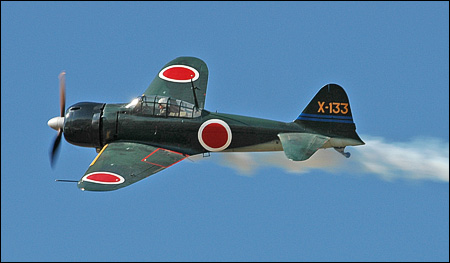
The Mitsubishi A6M Zero was a long-range fighter aircraft, manufactured by Mitsubishi Heavy Industries, and operated by the Imperial Japanese Navy from 1940 to 1945. The A6M was designated as the Mitsubishi Navy Type 0 Carrier Fighter, or the Mitsubishi A6M Rei-sen. The A6M was usually referred to by its pilots as the "Reisen" (zero fighter), "0" being the last digit of the Imperial year 2600 (1940) when it entered service with the Imperial Navy. The official Allied reporting name was "Zeke", although the use of the name "Zero" was later commonly adopted by the Allies as well.
When it was introduced early in World War II, the Zero was considered the most capable carrier-based fighter in the world, combining excellent maneuverability and very long range. In early combat operations, the Zero gained a legendary reputation as a dogfighter, achieving the outstanding kill ratio of 12 to 1, but by mid-1942 a combination of new tactics and the introduction of better equipment enabled the Allied pilots to engage the Zero on generally equal terms.
The Imperial Japanese Navy Air Service ("IJNAS") also frequently used the type as a land-based fighter. By 1943, inherent design weaknesses and the failure to develop more powerful aircraft engines meant that the Zero became less effective against newer enemy fighters, which possessed greater firepower, armor, and speed, and approached the Zero's maneuverability. Although the Mitsubishi A6M was outdated by 1944, design delays and production difficulties of newer Japanese aircraft types meant that it continued to serve in a front line role until the end of the war. During the final years of the War in the Pacific, the Zero was also adapted for use in kamikaze operations. During the course of the war, Japan produced more Zeros than any other model of combat aircraft.
General characteristics
Crew: one
Length: 9.06 m (29 ft 9 in)
Wingspan: 12.0 m (39 ft 4 in)
Height: 3.05 m (10 ft 0 in)
Wing area: 22.44 m² (241.5 ft²)
Empty weight: 1,680 kg (3,704 lb)
Loaded weight: 2,410 kg (5,313 lb)
Powerplant: 1 × Nakajima Sakae 12 radial engine, 709 kW (950 hp)
Aspect ratio: 6.4:
Performance
Never exceed speed: 660 km/h (356 kn, 410 mph)
Maximum speed: 533 km/h (287 kn, 331 mph) at 4,550 m (14,930 ft)
Range: 3,105 km (1,675 nmi, 1,929 mi)
Service ceiling: 10,000 m (33,000 ft)
Rate of climb: 15.7 m/s (3,100 ft/min)
Wing loading: 107.4 kg/m² (22.0 lb/ft²)
Power/mass: 294 W/kg (0.18 hp/lb)
Armament
Guns:
Divergence of trajectories between 7.7 mm and 20mm ammunition
2× 7.7 mm (0.303 in) Type 97 aircraft machine guns in the engine cowling, with 500 rounds per gun.
2× 20 mm Type 99-1 cannon in the wings, with 60 rounds per gun.
Bombs:
2× 60 kg (132 lb) bombs or
1× fixed 250 kg (551 lb) bomb for kamikaze attacks
Videos
Walkaround:
[youtube]RZ3frIAZG4s[/youtube]
From the cockpit:
[youtube]R6W9MBK1gJI[/youtube]
Take-off:
[youtube]iTAOEh4uY5Y[/youtube]
The Mitsubishi A6M Zero was a long-range fighter aircraft, manufactured by Mitsubishi Heavy Industries, and operated by the Imperial Japanese Navy from 1940 to 1945. The A6M was designated as the Mitsubishi Navy Type 0 Carrier Fighter, or the Mitsubishi A6M Rei-sen. The A6M was usually referred to by its pilots as the "Reisen" (zero fighter), "0" being the last digit of the Imperial year 2600 (1940) when it entered service with the Imperial Navy. The official Allied reporting name was "Zeke", although the use of the name "Zero" was later commonly adopted by the Allies as well.
When it was introduced early in World War II, the Zero was considered the most capable carrier-based fighter in the world, combining excellent maneuverability and very long range. In early combat operations, the Zero gained a legendary reputation as a dogfighter, achieving the outstanding kill ratio of 12 to 1, but by mid-1942 a combination of new tactics and the introduction of better equipment enabled the Allied pilots to engage the Zero on generally equal terms.
The Imperial Japanese Navy Air Service ("IJNAS") also frequently used the type as a land-based fighter. By 1943, inherent design weaknesses and the failure to develop more powerful aircraft engines meant that the Zero became less effective against newer enemy fighters, which possessed greater firepower, armor, and speed, and approached the Zero's maneuverability. Although the Mitsubishi A6M was outdated by 1944, design delays and production difficulties of newer Japanese aircraft types meant that it continued to serve in a front line role until the end of the war. During the final years of the War in the Pacific, the Zero was also adapted for use in kamikaze operations. During the course of the war, Japan produced more Zeros than any other model of combat aircraft.
General characteristics
Crew: one
Length: 9.06 m (29 ft 9 in)
Wingspan: 12.0 m (39 ft 4 in)
Height: 3.05 m (10 ft 0 in)
Wing area: 22.44 m² (241.5 ft²)
Empty weight: 1,680 kg (3,704 lb)
Loaded weight: 2,410 kg (5,313 lb)
Powerplant: 1 × Nakajima Sakae 12 radial engine, 709 kW (950 hp)
Aspect ratio: 6.4:
Performance
Never exceed speed: 660 km/h (356 kn, 410 mph)
Maximum speed: 533 km/h (287 kn, 331 mph) at 4,550 m (14,930 ft)
Range: 3,105 km (1,675 nmi, 1,929 mi)
Service ceiling: 10,000 m (33,000 ft)
Rate of climb: 15.7 m/s (3,100 ft/min)
Wing loading: 107.4 kg/m² (22.0 lb/ft²)
Power/mass: 294 W/kg (0.18 hp/lb)
Armament
Guns:
Divergence of trajectories between 7.7 mm and 20mm ammunition
2× 7.7 mm (0.303 in) Type 97 aircraft machine guns in the engine cowling, with 500 rounds per gun.
2× 20 mm Type 99-1 cannon in the wings, with 60 rounds per gun.
Bombs:
2× 60 kg (132 lb) bombs or
1× fixed 250 kg (551 lb) bomb for kamikaze attacks
Videos
Walkaround:
[youtube]RZ3frIAZG4s[/youtube]
From the cockpit:
[youtube]R6W9MBK1gJI[/youtube]
Take-off:
[youtube]iTAOEh4uY5Y[/youtube]


 Maybe one day I'll build an error free model...


