Some History
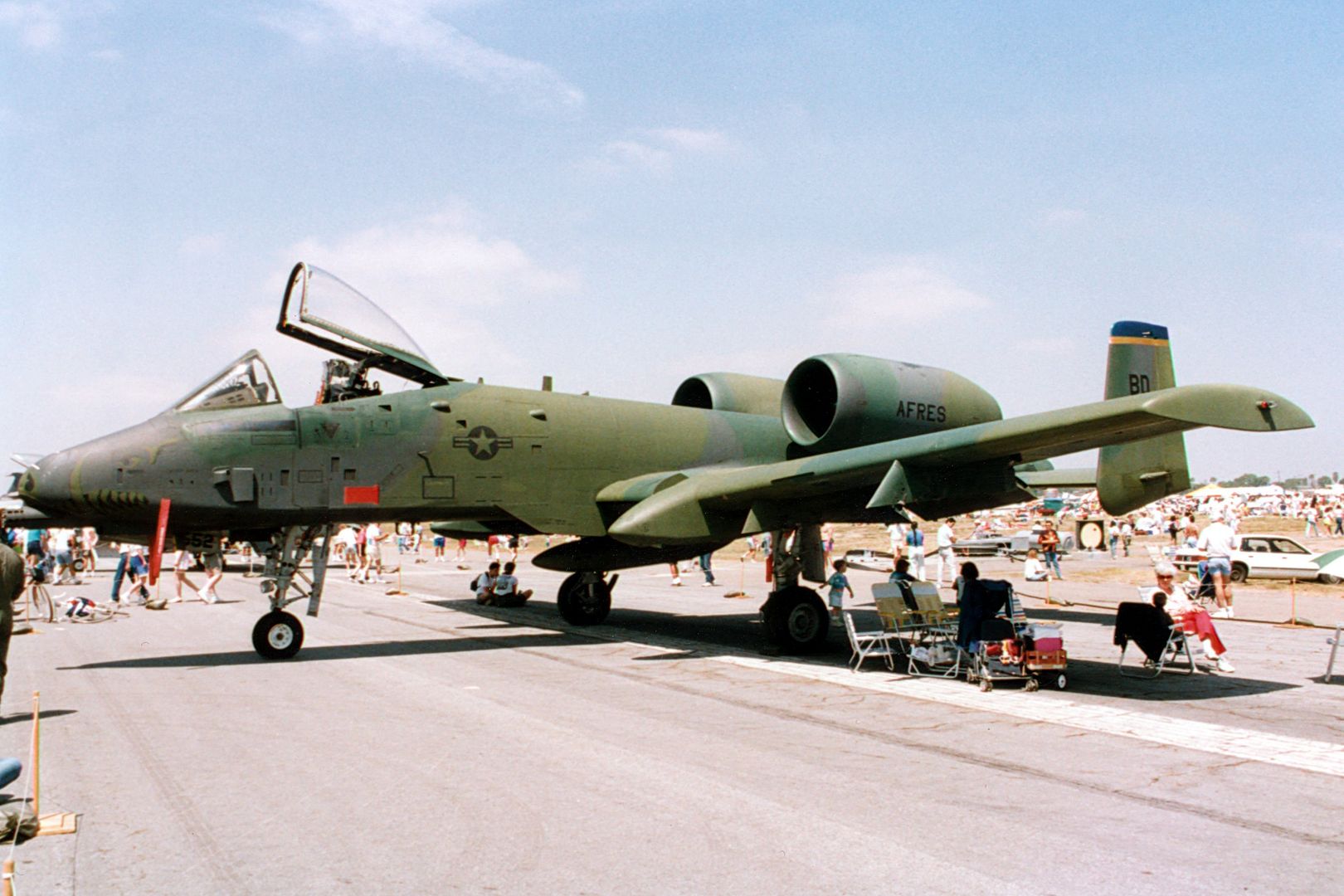
Fairchild Republic A-10 Thunderbolt II
Role Fixed-wing close air support, forward air control, and ground-attack aircraft
National origin United States
Manufacturer Fairchild Republic
First flight 10 May 1972
Introduction March 1977
Status In service
Primary user United States Air Force
Produced 1972–84[1]
Number built 716[2]
Unit cost
US$11.8 million (average, 1994 dollars)
The Fairchild Republic A-10 Thunderbolt II is an American twin-engine, straight wing jet aircraft developed by Fairchild-Republic in the early 1970s. It is the only United States Air Force production aircraft designed solely for close air support, including attacking tanks, armored vehicles, and other ground targets with limited air defenses.
The A-10 was designed around the 30 mm GAU-8 Avenger rotary cannon that is its primary armament. The A-10's airframe was designed for durability, with measures such as 1,200 pounds (540 kg) of titanium armor to protect the cockpit and aircraft systems, enabling it to absorb a significant amount of damage and continue flying. The A-10A single-seat variant was the only version built, though one A-10A was converted to an A-10B twin-seat version. In 2005, a program was begun to upgrade remaining A-10A aircraft to the A-10C configuration.
The A-10's official name comes from the Republic P-47 Thunderbolt of World War II, a fighter that was particularly effective at close air support. The A-10 is more commonly known by its nicknames "Warthog" or "Hog". Its secondary mission is to provide airborne forward air control, directing other aircraft in attacks on ground targets. Aircraft used primarily in this role are designated OA-10. With a variety of upgrades and wing replacements, the A-10's service life may be extended to 2028, though there are proposals to retire it sooner.
Background
Criticism that the U.S. Air Force did not take close air support (CAS) seriously prompted a few service members to seek a specialized attack aircraft.In the Vietnam War, large numbers of ground-attack aircraft were shot down by small arms, surface-to-air missiles, and low-level anti-aircraft gunfire, prompting the development of an aircraft better able to survive such weapons. In addition, the UH-1 Iroquois and AH-1 Cobra helicopters of the day, which USAF commanders had said should handle close air support, were ill-suited for use against armor, carrying only anti-personnel machine guns and unguided rockets meant for soft targets. Fast jets such as the F-100 Super Sabre, F-105 Thunderchief and F-4 Phantom II proved for the most part to be ineffective for close air support because their high speed did not allow pilots enough time to get an accurate fix on ground targets and they lacked sufficient loiter time. The effective, but aging, Korean War era A-1 Skyraider was the USAF's primary close air support aircraft.
A-X program
In 1966, the USAF formed the Attack Experimental (A-X) program office. On 6 March 1967, the Air Force released a request for information to 21 defense contractors for the A-X. The objective was to create a design study for a low-cost attack aircraft. In 1969, the Secretary of the Air Force asked Pierre Sprey to write the detailed specifications for the proposed A-X project; Sprey's initial involvement was kept secret due to his earlier controversial involvement in the F-X project. Sprey's discussions with Skyraider pilots operating in Vietnam and analysis of aircraft used in the role indicated the ideal aircraft should have long loiter time, low-speed maneuverability, massive cannon firepower, and extreme survivability; possessing the best elements of the Ilyushin Il-2, Henschel Hs 129, and Skyraider. The specifications also demanded that each aircraft cost less than $3 million. Sprey required that the biography of World War II Luftwaffe attack pilot Hans-Ulrich Rudel be read by people on the A-X program.
In May 1970, the USAF issued a modified, more detailed request for proposals (RFP) for the aircraft. The threat of Soviet armored forces and all-weather attack operations had become more serious. The requirements now included that the aircraft would be designed specifically for the 30 mm rotary cannon. The RFP also specified a maximum speed of 460 mph (400 kn; 740 km/h), takeoff distance of 4,000 feet (1,200 m), external load of 16,000 pounds (7,300 kg), 285-mile (460 km) mission radius, and a unit cost of US$1.4 million.[10] The A-X would be the first USAF aircraft designed exclusively for close air support. During this time, a separate RFP was released for A-X's 30 mm cannon with requirements for a high rate of fire (4,000 round/minute) and a high muzzle velocity. Six companies submitted aircraft proposals, with Northrop and Fairchild Republic selected to build prototypes: the YA-9A and YA-10A, respectively. General Electric and Philco-Ford were selected to build and test GAU-8 cannon prototypes.
Two YA-10 prototypes were built in the Republic factory in Farmingdale, New York and first flew on 10 May 1972 by pilot Howard "Sam" Nelson. Production A-10's were built at Fairchild in Hagerstown, Maryland. After trials and a fly-off against the YA-9, on 18 January 1973, the USAF announced the YA-10's selection for production. General Electric was selected to build the GAU-8 cannon in June 1973. The YA-10 had an additional fly-off in 1974 against the Ling-Temco-Vought A-7D Corsair II, the principal USAF attack aircraft at the time, in order to prove the need for a new attack aircraft. The first production A-10 flew in October 1975, and deliveries commenced in March 1976. In total, 715 airplanes were produced, the last delivered in 1984.
One experimental two-seat A-10 Night Adverse Weather (N/AW) version was built by converting an A-10A. The N/AW was developed by Fairchild from the first Demonstration Testing and Evaluation (DT&E) A-10 for consideration by the USAF. It included a second seat for a weapons system officer responsible for electronic countermeasures (ECM), navigation and target acquisition. The N/AW version did not interest the USAF or export customers. The two-seat trainer version was ordered by the Air Force in 1981, but funding was canceled by U.S. Congress and the jet was not produced. The only two-seat A-10 built now resides at Edwards Air Force Base's Flight Test Center Museum.
Upgrades[edit]
The A-10 has received many upgrades over the years. From 1978 onwards, the Pave Penny laser receiver pod was adopted, which receives reflected laser radiation from laser designators for faster and more accurate target identification. The A-10 began receiving an inertial navigation system in 1980. The Low-Altitude Safety and Targeting Enhancement (LASTE) upgrade provided computerized weapon-aiming equipment, an autopilot, and a ground-collision warning system. The A-10 is compatible with night vision goggles for low-light operation. In 1999, aircraft began receiving Global Positioning System navigation systems and a multi-function display. The LASTE system was upgraded with Integrated Flight & Fire Control Computers (IFFCC).
An A-10A of pre-glass cockpit design
In 2005, the entire A-10 fleet began receiving the Precision Engagement upgrades that include an improved fire control system (FCS), electronic countermeasures (ECM), and smart bomb targeting. Aircraft which received this upgrade are redesignated A-10C; work was to be completed in 2011. The Government Accounting Office in 2007 estimated the cost of upgrading, refurbishing, and service life extension plans for the A-10 force to total $2.25 billion through 2013. The Air Force Material Command's Ogden Air Logistics Center at Hill AFB, Utah completed work on its 100th A-10 precision engagement upgrade in January 2008.
In 2007, the A-10 was subject to a service life extension program (SLEP); Boeing was awarded a contract to build as many as 242 A-10 wing sets in June 2007. In November 2011, two A-10s flew with the new wing fitted. In September 2013, the USAF awarded Boeing a $212 million follow-on contract for 56 new wings, increasing the total ordered to 173. Re-winging improves mission readiness, decreases maintenance costs, and allows the A-10 to be operated up to 2035. In plans to retire the A-10, the USAF is considering halting the wing replacement program, saving an additional $500 million on top of the total saving of retiring the fleet. If the USAF kept the 42 A-10s already re-winged while retiring all others, the savings would be $1 billion compared to $4.2 billion for complete retirement.
In 2012, Air Combat Command requested the testing of a 600-gallon external fuel tank which would extend the A-10's loitering time by 45–60 minutes; flight testing of such a tank was conducted in 1997, but did not involve combat evaluation. Over 30 flight tests were conducted by the 40th Flight Test Squadron to gather data on the aircraft's handling characteristics and performance across different load configurations. The tank slightly reduced stability in the yaw axis, however there is no decrease in aircraft tracking performance.
In July 2010, the USAF issued Raytheon a contract to integrate a Helmet Mounted Integrated Targeting (HMIT) system onto A-10Cs. The Gentex Corporation Scorpion Helmet Mounted Cueing System (HMCS) was also evaluated. In February 2014, SoAF Deborah Lee James ordered that development of Suite 8 software upgrade continue, in response to Congressional pressure. Software upgrades were originally to be ceased due to plans to retire the A-10. Suite 8 software includes IFF Mod 5, which allows friendly units to identify the A-10 as a friendly aircraft.
Other uses
On 25 March 2010, an A-10 conducted the first flight of an aircraft with all engines powered by a biofuel blend. The flight, performed at Eglin Air Force Base, used a 1:1 blend of JP-8 and Camelina-based fuel. On 28 June 2012, the A-10 became the first aircraft to fly using a new fuel blend derived from alcohol; known as ATJ (Alcohol-to-Jet), the fuel is cellulousic-based that can be derived using wood, paper, grass, or any cell-based material, and are fermented into alcohols before being hydro-processed into aviation fuel. ATJ is the third alternative fuel to be evaluated by the Air Force as a replacement for petroleum-derived JP-8 fuel. Previous types were a synthetic paraffinic kerosene derived from coal and natural gas and a bio-mass fuel derived from plant-oils and animal fats known as Hydroprocessed Renewable Jet.
In 2011, the National Science Foundation granted $11 million to modify an A-10 for weather research for CIRPAS at the U.S. Naval Postgraduate School, replacing a retired North American T-28 Trojan. The A-10's armor is expected to allow it to survive the extreme meteorological conditions, such as 200 mph hailstorms, found in inclement high-altitude weather events.
In 2015, Boeing revealed that it was holding initial discussions on the prospects of selling retired or stored A-10s in near-flyaway condition to international customers. However, the Air Force has "no intention at all" of selling A-10s to anyone.
Overview
crucial internal components
A-10 inboard profile drawing
The A-10 has superior maneuverability at low speeds and altitude because of its large wing area, high wing aspect ratio, and large ailerons. The wing also allows short takeoffs and landings, permitting operations from primitive forward airfields near front lines. The aircraft can loiter for extended periods and operate under 1,000 ft (300 m) ceilings with 1.5 mi (2.4 km) visibility. It typically flies at a relatively low speed of 300 knots (350 mph; 560 km/h), which makes it a better platform for the ground-attack role than fast fighter-bombers, which often have difficulty targeting small, slow-moving targets.
The leading edge of the wing has a honeycomb structure panel construction, providing strength with minimal weight; similar panels cover the flap shrouds, elevators, rudders and sections of the fins. The skin panels are integral with the stringers and are fabricated using computer-controlled machining, reducing production time and cost. Combat experience has shown that this type of panel is more resistant to damage. The skin is not load-bearing, so damaged skin sections can be easily replaced in the field, with makeshift materials if necessary. The ailerons are at the far ends of the wings for greater rolling moment and have two distinguishing features: The ailerons are larger than is typical, almost 50 percent of the wingspan, providing improved control even at slow speeds; the aileron is also split, making it a deceleron.
The A-10 is designed to be refueled, rearmed, and serviced with minimal equipment. Also, most repairs can be done in the field. An unusual feature is that many of the aircraft's parts are interchangeable between the left and right sides, including the engines, main landing gear, and vertical stabilizers. The sturdy landing gear, low-pressure tires and large, straight wings allow operation from short rough strips even with a heavy aircraft ordnance load, allowing the aircraft to operate from damaged airbases, flying from taxiways or even straight roadway sections.
front landing gear
The front landing gear is offset to the aircraft's right to allow placement of the 30 mm cannon with its firing barrel along the centerline of the aircraft. During ground taxi, the offset front landing gear causes the A-10 to have dissimilar turning radii. Turning to the right on the ground takes less distance than turning left. The wheels of the main landing gear partially protrude from their nacelles when retracted, making gear-up belly landings easier to control and less damaging. All landing gears are hinged toward the aircraft's rear; if hydraulic power is lost, a combination of gravity and wind resistance can open and lock the gear in place.
Durability
The A-10 is exceptionally tough, being able to survive direct hits from armor-piercing and high-explosive projectiles up to 23 mm. It has double-redundant hydraulic flight systems, and a mechanical system as a back up if hydraulics are lost. Flight without hydraulic power uses the manual reversion control system; pitch and yaw control engages automatically, roll control is pilot-selected. In manual reversion mode, the A-10 is sufficiently controllable under favorable conditions to return to base, though control forces are greater than normal. The aircraft is designed to fly with one engine, one tail, one elevator, and half of one wing missing.
The cockpit and parts of the flight-control system are protected by 1,200 lb (540 kg) of titanium aircraft armor, referred to as a "bathtub". The armor has been tested to withstand strikes from 23 mm cannon fire and some strikes from 57 mm rounds. It is made up of titanium plates with thicknesses from 0.5 to 1.5 inches (13 to 38 mm) determined by a study of likely trajectories and deflection angles. The armor makes up almost 6 percent of the aircraft's empty weight. Any interior surface of the tub directly exposed to the pilot is covered by a multi-layer nylon spall shield to protect against shell fragmentation. The front windscreen and canopy are resistant to small arms fire.
Freedom in 2003
The A-10's durability was shown on 7 April 2003 when Captain Kim Campbell, while flying over Baghdad during the 2003 invasion of Iraq, suffered extensive flak damage. Iraqi fire damaged an engine and crippled the hydraulic system, requiring the aircraft's stabilizer and flight controls to be operated via the 'manual reversion mode'. Despite this damage, Campbell flew the aircraft for nearly an hour and landed safely.
The A-10 was envisioned to fly from forward air bases and semi-prepared runways with high risk of foreign object damage to the engines. The unusual location of the General Electric TF34-GE-100 turbofan engines decreases ingestion risk, and allows the engines to run while the aircraft is serviced and rearmed by ground crews, reducing turn-around time. The wings are also mounted closer to the ground, simplifying servicing and rearming operations. The heavy engines require strong supports, four bolts connect the engine pylons to the airframe. The engines' high 6:1 bypass ratio have a relatively small infrared signature, and their position directs exhaust over the tailplanes further shielding it from detection by infrared homing surface-to-air missiles. The engines are angled upward by nine degrees to cancel out the nose-down pitching moment they would otherwise generate due to being mounted above the aircraft's center of gravity, avoiding the need to trim the control surfaces against the force.
To reduce the likelihood of damage to the A-10's fuel system, all four fuel tanks are located near the aircraft's center and are separated from the fuselage; projectiles would need to penetrate the aircraft's skin before reaching a tank's outer skin. Compromised fuel transfer lines self-seal; if damage exceeds a tank's self-sealing capabilities, check valves prevent fuel flowing into a compromised tank. Most fuel system components are inside the tanks so that fuel will not be lost due to component failure. The refueling system is also purged after use. Reticulated polyurethane foam lines both the inner and outer sides of the fuel tanks, retaining debris and restricting fuel spillage in the event of damage. The engines are shielded from the rest of the airframe by firewalls and fire extinguishing equipment. In the event of all four main tanks being lost, two self-sealing sump tanks contain fuel for 230 miles (370 km) of flight.
Weapons
Although the A-10 can carry considerable disposable stores, its primary built-in weapon is the 30 mm GAU-8/A Avenger Gatling-type cannon. One of the most powerful aircraft cannon ever flown, it fires large depleted uranium armor-piercing shells. In the original design, the pilot could switch between two rates of fire: 2,100 or 4,200 rounds per minute; this was changed to a fixed rate of 3,900 rounds per minute. The cannon takes about half a second to come up to speed, so 50 rounds are fired during the first second, 65 or 70 rounds per second thereafter. The gun is accurate enough to place 80 percent of its shots within a 40-foot (12.4 m) diameter circle from 4,000 feet (1,220 m) while in flight.[63] The GAU-8 is optimized for a slant range of 4,000 feet (1,220 m) with the A-10 in a 30 degree dive.
The fuselage of the aircraft is built around the cannon. The GAU-8/A is mounted slightly to the port side; the barrel in the firing location is on the starboard side at the 9 o'clock position so it is aligned with the aircraft's centerline. The gun's 5-foot, 11.5-inch (1.816 m) ammunition drum can hold up to 1,350 rounds of 30 mm ammunition, but generally holds 1,174 rounds. To prevent enemy fire from causing the GAU-8/A rounds to fire prematurely, armor plates of differing thicknesses between the aircraft skin and the drum are designed to detonate incoming shells. A final armor layer around the drum protects it from fragmentation damage. The gun is loaded by Syn-Tech's linked tube carrier GFU-7/E 30 mm ammunition loading assembly cart.
The AGM-65 Maverick air-to-surface missile is a commonly used munition, targeted via electro-optical (TV-guided) or infrared. The Maverick allows target engagement at much greater ranges than the cannon, and thus less risk from anti-aircraft systems. During Desert Storm, in the absence of dedicated forward-looking infrared (FLIR) cameras for night vision, the Maverick's infrared camera was used for night missions as a "poor man's FLIR". Other weapons include cluster bombs and Hydra rocket pods. The A-10 is equipped to carry laser-guided bombs. A-10s usually fly with an ALQ-131 ECM pod under one wing and two AIM-9 Sidewinder air-to-air missiles under the other wing for self-defense.

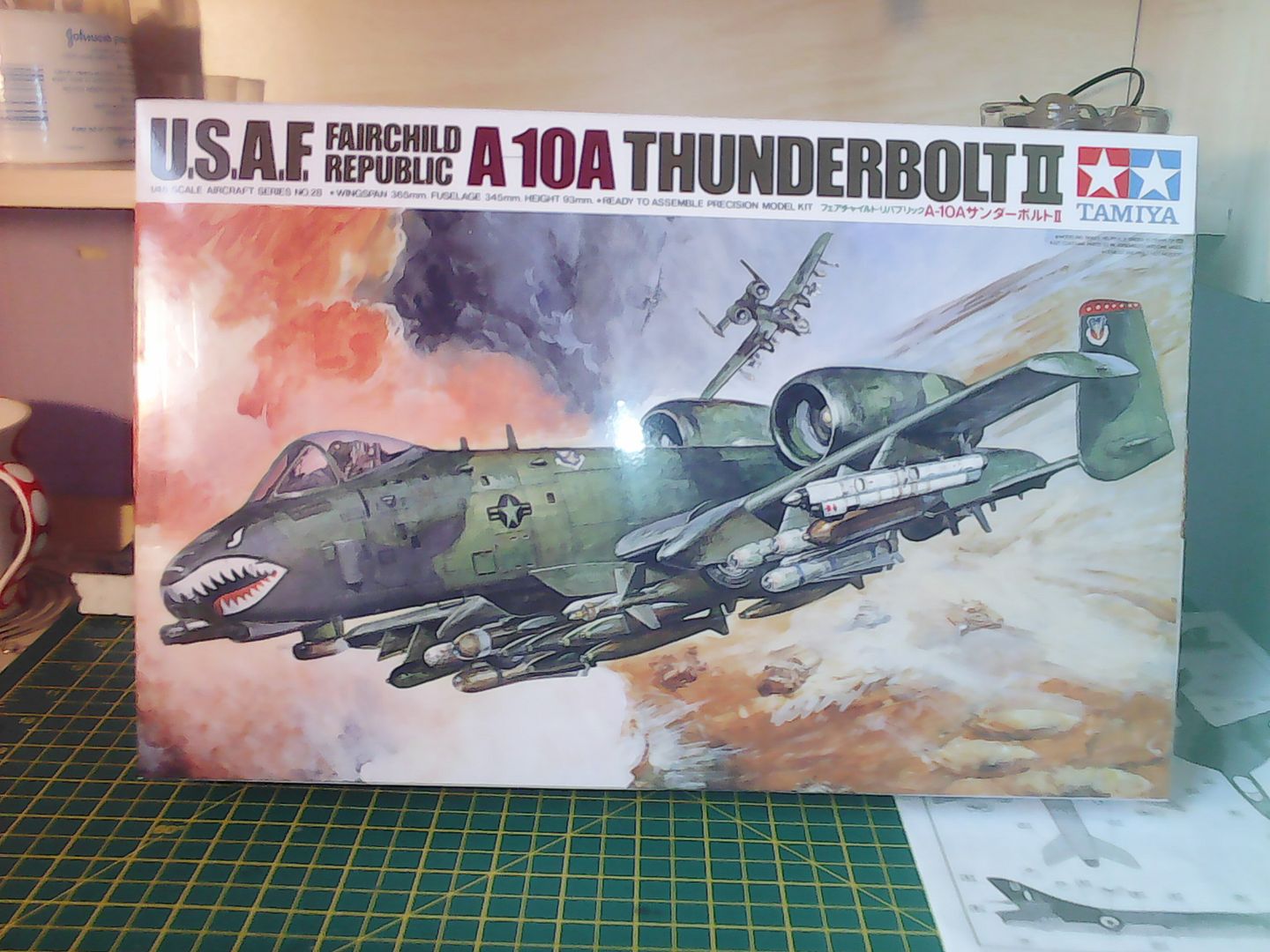


 Got this in the stash.


