Doolittle Raiders - North American B-25B Mitchell
Posted: Mon May 23, 2016 8:49 pm

Welcome along to my entry into this Group Build. I haven't done a WW2 aircraft for a while, and so I thought I would combine this with this Group Build.
As you can probably tell from the topic title, I am going to be building a B-25B Mitchell bomber as was involved in the famous Doolittle Raid of 18th April 1942. The main fact that makes this bombing raid so famous is that the raid (consisting of 16 B-25Bs) was launched from the USS Hornet aircraft carrier, and was the first time the US was able to launch a military strike against the Japanese main islands.
The raid is called the "Doolittle Raid" or "Tokyo Raid" after the man who planned the mission, Lt. Col. James "Jimmy" Doolittle, USAAF. The concept for the attack came from Navy Captain Francis Low, Assistant Chief of Staff for anti-submarine warfare, who reported to Admiral Ernest J. King on 10 January 1942 that he thought twin-engine Army bombers could be launched from an aircraft carrier, after observing several at a naval airfield in Norfolk, Virginia, where the runway was painted with the outline of a carrier deck for landing practice. The attack was planned and led by Doolittle, a famous military test pilot, civilian aviator and aeronautical engineer before the war.The plan was to embark 15 B-25B Mitchell medium bombers onto an aircraft carrier and move this task force to within 450 miles of the Japanese mainland, and launch a bombing strike against Tokyo and other cities. The pilots for this mission were chosen from the 17th Bomb Group (Medium) which was not only the first medium bomber group in the US Army Air Corps, but also had the most experienced B-25 pilots. The group was originally part of the US 8th Air Force.
In order to determine the viability of launching a medium bomber from an aircraft carrier, two B-25s were loaded onto the USS Hornet whilst at Norfolk, Virginia. Trials conducted resulted in the successful launch of the B-25s from the carrier, showing the plan was indeed viable. However the bombers to be involved in the raid underwent quite an extensive amount of modification, in secrecy, to prepare them for the raid.
The 17th BG, then flying antisubmarine patrols from Pendleton, Oregon, was immediately moved cross-country to Lexington County Army Air Base at Columbia, South Carolina, ostensibly to fly similar patrols off the east coast of the United States but in actuality to prepare for the mission against Japan. The group officially transferred effective 9 February to Columbia, where its combat crews were offered the opportunity to volunteer for an "extremely hazardous", but unspecified mission. On 17 February, the group was detached from the Eighth Air Force.
Initial planning called for 20 aircraft to fly the mission, and 24 of the group's B-25B Mitchell bombers were diverted to the Mid-Continent Airlines modification center in Minneapolis, Minnesota. With support provided by two senior airline managers, Wold-Chamberlain Field's maintenance hangar was the first modification center to become operational. From nearby Fort Snelling, the 710th Military Police Battalion provided tight security around this hangar. Modifications included:
Removal of the lower gun turret
Installation of de-icers and anti-icers
Steel blast plates mounted on the fuselage around the upper turret
Removal of the liaison radio set (a weight impediment)
Installation of a 160-gallon collapsible neoprene auxiliary fuel tank fixed to the top of the bomb bay, and support mounts for additional fuel cells in the bomb bay, crawlway and lower turret area to increase fuel capacity from 646 to 1,141 U.S. gallons (538–950 imperial gallons; 2,445–4,319 L)
Mock gun barrels installed in the tail cone
Replacement of their Norden bombsight with a makeshift aiming sight devised by pilot Captain Charles Ross Greening and called the "Mark Twain". The materials for the bombsight cost only 20 cents.
Two bombers also had cameras mounted to record the results of bombing. The 24 crews selected picked up the modified bombers in Minneapolis and flew them to Eglin Field, Florida, beginning 1 March 1942. There, the crews received concentrated training for three weeks in simulated carrier deck takeoffs, low-level and night flying, low-altitude bombing and over-water navigation, primarily out of Wagner Field, Auxiliary Field 1. Lieutenant Henry Miller, USN, from nearby Naval Air Station Pensacola supervised their takeoff training and accompanied the crews to the launch. For his efforts, Miller is considered an honorary member of the Raider group.
Doolittle stated in his after-action report that the crews reached a "safely operational" level of training, despite several days when flying was not possible because of rain and fog. One aircraft was heavily damaged in a takeoff accident and another removed from the mission because of a nose wheel shimmy that could not be repaired in time.
On 25 March 1942, the remaining 22 B-25s took off from Eglin for McClellan Field, California. They arrived two days later at the Sacramento Air Depot for final modifications. A total of 16 B-25s were subsequently flown to NAS Alameda, California, on 31 March. Fifteen made up the mission force and the sixteenth, by last-minute agreement with the Navy, was squeezed onto the deck to be flown off shortly after departure from San Francisco to provide feedback to the Army pilots about takeoff characteristics. Instead, that bomber was made part of the mission force.
The Mission:
On 1 April 1942, the 16 modified bombers, their five-man crews and Army maintenance personnel, totaling 71 officers and 130 enlisted men, were loaded onto the USS Hornet at Naval Air Station Alameda. Each aircraft carried four specially constructed 500-pound (225 kg) bombs. Three of these were high-explosive munitions and one was a bundle of incendiaries. The incendiaries were long tubes, wrapped together in order to be carried in the bomb bay, but designed to separate and scatter over a wide area after release. Five bombs had Japanese "friendship" medals wired to them—medals awarded by the Japanese government to U.S. servicemen before the war. The bombers' armament was reduced to increase range by decreasing weight. Each bomber launched with two .50-caliber (12.7 mm) machine guns in an upper turret and a .30-caliber (7.62 mm) machine gun in the nose. The aircraft were clustered closely and tied down on Hornet's flight deck in the order of launch.
Orders in hand, Navy Capt. Marc A. Mitscher, skipper of the USS Hornet, chats with Lt. Col. James Doolittle.
Hornet and Task Force 18 left the port of Alameda at 10:00 on 2 April and a few days later rendezvoused with Task Force 16, commanded by Vice Admiral William F. Halsey, Jr.—the carrier USS Enterprise and her escort of cruisers and destroyers in the mid-Pacific Ocean north of Hawaii. Enterprise's fighters and scout planes provided protection for the entire task force in the event of a Japanese air attack, since Hornet's fighters were stowed below decks to allow the B-25s to use the flight deck. The combined force was two carriers, three heavy cruisers, one light cruiser, eight destroyers and two fleet oilers. The escort ships—Salt Lake City, Northampton, Vincennes, Nashville, Balch, Fanning, Benham, Ellet, Gwin, Meredith, Grayson, Monssen, Cimarron and Sabine—then proceeded in radio silence. On the afternoon of 17 April, the slow oilers refueled the task force, then withdrew with the destroyers to the east while the carriers and cruisers dashed west at 20 kn (37 km/h; 23 mph) toward their intended launch point in enemy-controlled waters east of Japan.
No.23 Nittō Maru sinking by USS Nashville
Doolittle's B-25 at launching, 18 April 1942.
At 07:38 on the morning of 18 April, while the task force was still about 650 nautical miles (1,200 km; 750 mi) from Japan (at approximately 35°N 154°E), it was sighted by the Japanese picket boat No. 23 Nittō Maru, a 70-ton patrol craft, which radioed an attack warning to Japan. The boat was sunk by gunfire from USS Nashville. The chief petty officer who captained the boat committed suicide rather than be captured, but five of the 11 crew were picked up by Nashville. Doolittle and Hornet skipper Captain Marc Mitscher decided to launch the B-25s immediately—10 hours early and 170 nautical miles (310 km; 200 mi) farther from Japan than planned. After re-spotting to allow for engine start and runups, Doolittle's aircraft had 467 feet (142 m) of takeoff distance. Although none of the B-25 pilots, including Doolittle, had ever taken off from a carrier before, all 16 aircraft launched safely between 08:20 and 09:19. (The 16th B-25 had been included only as a reserve, intended to fly along as an observation and photographic platform, but when surprise was compromised, Doolittle decided to use all 16 aircraft in the attack.)
The B-25s then flew toward Japan, most in groups of two to four aircraft, before flying single file at wave-top level to avoid detection. The aircraft began arriving over Japan about noon Tokyo time, six hours after launch, and bombed 10 military and industrial targets in Tokyo, two in Yokohama and one each in Yokosuka, Nagoya, Kobe and Osaka. Although some B-25s encountered light antiaircraft fire and a few enemy fighters over Japan, no bomber was shot down. Only the B-25 of Lieutenant Richard O. Joyce received any battle damage, minor hits from antiaircraft fire. B-25 No. 4, piloted by Lieutenant Everett W. Holstrom, jettisoned its bombs before reaching its target when it came under attack by fighters after its gun turret malfunctioned. At least one Japanese fighter was shot down by the gunners of the Whirling Dervish, piloted by Lieutenant Harold Watson. Two other fighters were shot down by the gunners of the Hari Kari-er, piloted by Ross Greening. Many military targets were strafed by the bombers' nose gunners. The subterfuge of the simulated gun barrels mounted in the tail cones was described afterwards by Doolittle as effective, in that no airplane was attacked from directly behind.
Fifteen of the sixteen aircraft then proceeded southwest along the southern coast of Japan and across the East China Sea toward eastern China, where several fields in Zhejiang province were supposed to be ready to guide them in using homing beacons, then recover and refuel them for continuing on to Chongqing, the wartime Kuomintang capital. The primary base was at Zhuzhou, toward which all the aircraft navigated, but Halsey never sent the planned signal to alert them, apparently because of a possible threat to the task force. One B-25, piloted by Captain Edward J. York, was extremely low on fuel, and headed instead for the closer Soviet Union.
The raiders faced several unforeseen challenges during their flight to China: night was approaching, the aircraft were running low on fuel and the weather was rapidly deteriorating. None would have reached China if not for a tail wind as they came off the target, which increased their ground speed by 25 kn (46 km/h; 29 mph) for seven hours. The crews realized they would probably not be able to reach their intended bases in China, leaving them the option of either bailing out over eastern China or crash-landing along the Chinese coast. Fifteen aircraft reached the Chinese coast after 13 hours of flight and crash-landed or the crews bailed out; the crew who flew to the Soviet Union landed 40 miles (65 km) beyond Vladivostok, where their B-25 was confiscated and the crew interned. It was the longest combat mission ever flown by the B-25 Mitchell medium bomber, averaging approximately 2,250 nautical miles (4,170 km). Although York and his crew were well-treated, diplomatic attempts to return them to the United States ultimately failed. Eventually, they were relocated to Ashgabat, 20 miles (32 km) from the Iranian border, and York managed to "bribe" a smuggler, who helped them cross the border and reach a nearby British consulate on 11 May 1943. The smuggling was actually staged by the NKVD, according to declassified Soviet archives, because the Soviet government was unable to repatriate them legally in the face of the neutrality pact with Japan.
Doolittle and his crew, after parachuting into China, received assistance from Chinese soldiers and civilians as well as John Birch, an American missionary in China. As did the others who participated in the mission, Doolittle had to bail out, but fortunately he landed in a heap of dung (saving a previously injured ankle from breaking) in a paddy in China near Quzhou. Doolittle felt the raid had been a terrible failure because all the aircraft were lost, and he expected to be court-martialed on his return. He subsequently recommended Birch for intelligence work with Claire Chennault's Flying Tigers.
One crewman, Corporal Leland D. Faktor, flight engineer/gunner with Gray, was killed during his bailout attempt over China, the only man in that crew to be lost. Two crews (10 men) were missing.
Surviving airmen
Colonel Richard E. Cole, copilot of aircraft No. 1 (age 100)
Staff Sergeant David J. Thatcher, gunner of aircraft No. 7 (age 93)
Seven other men, including Lt. Miller and raider historian Col. Carroll V. Glines, are considered honorary Raiders for their efforts for the mission.
Colonel Bill Bower, the last surviving Doolittle raider full pilot, died on 10 January 2011 at age 93 in Boulder, Colorado. Lieutenant Colonel Edward Saylor, the then-enlisted engineer/gunner of aircraft No. 15 during the raid, died on Wednesday, 28 January 2015 of natural causes at his home in Sumner, Washington. Lieutenant Colonel Robert L. Hite, copilot of the plane piloted by Lt. William G. Farrow, died in a nursing home at the age of 95 on 29 March 2015. Colonel Richard Cole and Staff Sergeant David J. Thatcher are the last surviving Doolittle Raiders.
I will dedicate this build to the memory of the Doolittle Raiders.
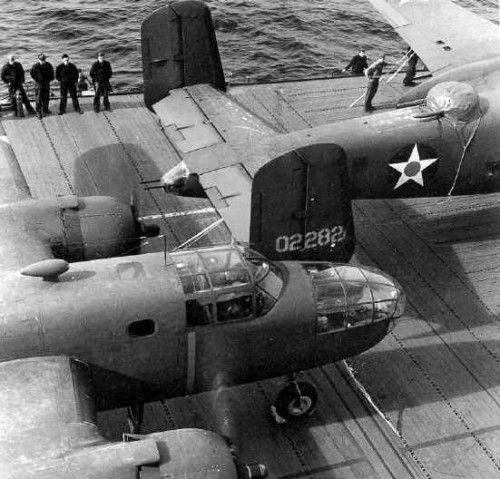
Before we get onto the kit, here are some more reference images of the actual B-25s involved in the raid, whilst loaded on the USS Hornet en route to the target.



The kit
So the kit I intend to use in this build is the Academy 1/48 B-25B Mitchell "Doolittle Raiders". The box art can be seen below.


The series of pictures below show the contents of the kit and the sprues included and some close ups of the very nice detail present on this kit.


Phew! Quite a few pics, but I hope that gives you an idea of the kit. I think it looks really nicely detailed, with very fine surface details and a full interior.
If you remember back to the start of this post, there is a list of the modifications that were made to the B-25s for this particular mission. I intend to incorporate as many of those changes into the kit as possible. I haven't checked for sure, but I think the broomstick rear machine guns are included in the kit, so I will check what is there, and what will need made. The extra fuel tanks in the bomb bay etc. may well need scratch built, but may also be pointless if you won't be able to see it once completed.
I am not sure what aircraft I will model yet. I am sure most people would choose Doolittles own aircraft, but I think I might do it as one of the ones where the crew didn't make it home.
 Awesome subject and really enjoy the history of so many of these builds