Nevs Supermarine Walrus Mk 1
Posted: Tue Jul 05, 2016 11:15 pm
Hi for this build I would like to have a go at this Revell 1/72 Supermarine Walrus. Truth is it's the only floaty thing in my stash! Was given as a job lot of kits, so perfect timing for this build thread 


So quite a basic little kit lets hope it fits ok...
Here is a little history of the plane with some videos & images
[youtube]tyGklwaGyD4[/youtube]
[youtube]4-2UAXblTUE[/youtube]


The Supermarine Walrus was a British single-engine amphibious biplane reconnaissance aircraft designed by R. J. Mitchell and first flown in 1933. It was operated by the Fleet Air Arm (FAA) and also served with the Royal Air Force (RAF), Royal Australian Air Force (RAAF), Royal New Zealand Navy (RNZN) and Royal New Zealand Air Force (RNZAF). It was the first British squadron-service aircraft to incorporate a fully retractable main undercarriage, completely enclosed crew accommodation, and an all-metal fuselage in one airframe.
Designed for use as a fleet spotter to be catapult launched from cruisers or battleships, the Walrus was later employed in a variety of other roles, most notably as a rescue aircraft for downed aircrew. It continued in service throughout the Second World War.
The Walrus was initially developed as a private venture in response to a 1929 Royal Australian Air Force (RAAF) requirement for an aircraft to be catapult-launched from cruisers, and was originally called the Seagull V, although it only resembled the earlier Supermarine Seagull III in general layout. Construction was started in 1930 but owing to Supermarine's other commitments it was not completed until 1933.
The single-step hull was constructed from aluminium alloy, with stainless-steel forgings for the catapult spools and mountings. Metal construction was used because experience had shown that wooden structures deteriorated rapidly under tropical conditions. The wings, which were slightly swept back, had stainless–steel spars and wooden ribs and were covered in fabric. The lower wings were set in the shoulder position with a stabilising float mounted under each one. The horizontal tail-surfaces were positioned high on the tail-fin and braced on either side by N stuts. The wings could be folded on ship, giving a stowage width of 17 feet 6 inches (5.33 m). The single 620 hp (460 kW) Pegasus II M2 radial engine was housed at the rear of a nacelle mounted on four struts above the lower wing and braced by four shorter struts to the centre-section of the upper wing. This powered a four-bladed wooden propeller in pusher configuration. The engine nacelle contained the oil tank, arranged around the air intake at the front of the nacelle to act as an oil cooler, and electrical equipment and had a number of access panels for maintenance. A supplementary oil cooler was mounted on the starboard side. Fuel was carried in two tanks in the upper wings. The pusher configuration had the advantages of keeping the engine and propeller further out of the way of spray when operating on water and reducing the noise level inside the aircraft. Also, the moving propeller was safely away from any crew standing on the front deck, which would be done when picking up a mooring line. The engine was offset by three degrees to starboard to counter any tendency of the aircraft to yaw due to unequal forces on the rudder caused by the vortex from the propeller.
A solid aluminium tailwheel was enclosed within a small water-rudder, which could be coupled to the main rudder for taxiing or disengaged for takeoff and landing.
Although the aircraft typically flew with one pilot, there were positions for two. The left-hand position was the main one, with the instrument panel and a fixed seat, while the right-hand seat could be folded away to allow access to the nose gun-position via a crawl-way. An unusual feature was that the control column was not a fixed fitting in the usual way, but could be unplugged from either of two sockets at floor level. It became a habit for only one column to be in use; and when control was passed from the pilot to co-pilot or vice versa, the control column would simply be unplugged and handed over. Behind the cockpit, there was a small cabin with work stations for the navigator and radio operator.
Armament usually consisted of two .303 in (7.7 mm) Vickers K machine guns, one in each of the open positions in the nose and rear fuselage; with provision for carrying bombs or depth charges mounted beneath the lower wings. Like other flying boats, the Walrus carried marine equipment for use on the water, including an anchor, towing and mooring cables, drogues and a boat-hook.
Operational history
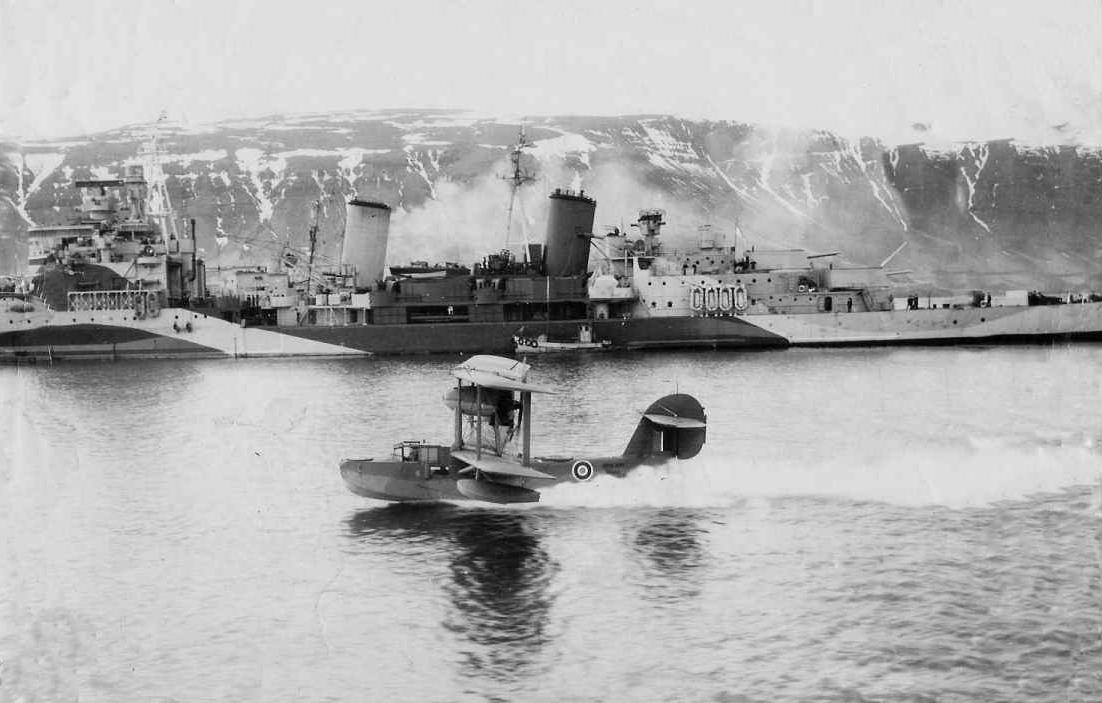
Walrus deliveries to the RAF started in 1936 when the first example to be deployed was assigned to the New Zealand division of the Royal Navy, on Achilles– one of the Leander-class light cruisers that carried one Walrus each. The Royal Navy Town-class cruisers carried two Walruses during the early part of the war and Walruses also equipped the York-class and County-class heavy cruisers. Some battleships, such as Warspite and Rodney carried Walruses, as did the monitor Terror and the seaplane tender Albatross.
By the start of World War II the Walrus was in widespread use. Although its principal intended use was gunnery spotting in naval actions, this only occurred twice: Walruses from Renown and Manchester were launched in the Battle of Cape Spartivento and a Walrus from Gloucester was used in the Battle of Cape Matapan.[18] The main task of ship-based aircraft was patrolling for Axis submarines and surface-raiders, and by March 1941, Walruses were being deployed with Air to Surface Vessel (ASV) radars to assist in this. During the Norwegian Campaign and the East African Campaign, they also saw very limited use in bombing and strafing shore targets. In August 1940, a Walrus operating from Hobart bombed and machine-gunned an Italian headquarters at Zeila in Somalia.
By 1943, catapult-launched aircraft on cruisers and battleships were being phased out; their role at sea was taken over by much improved radar. Also, a hangar and catapult occupied a considerable amount of valuable space on a warship. However, Walruses continued to fly from Royal Navy carriers for air-sea rescue and general communications tasks. Their low landing speed meant they could make a carrier landing despite having no flaps or tailhook.


So quite a basic little kit lets hope it fits ok...
Here is a little history of the plane with some videos & images
[youtube]tyGklwaGyD4[/youtube]
[youtube]4-2UAXblTUE[/youtube]
The Supermarine Walrus was a British single-engine amphibious biplane reconnaissance aircraft designed by R. J. Mitchell and first flown in 1933. It was operated by the Fleet Air Arm (FAA) and also served with the Royal Air Force (RAF), Royal Australian Air Force (RAAF), Royal New Zealand Navy (RNZN) and Royal New Zealand Air Force (RNZAF). It was the first British squadron-service aircraft to incorporate a fully retractable main undercarriage, completely enclosed crew accommodation, and an all-metal fuselage in one airframe.
Designed for use as a fleet spotter to be catapult launched from cruisers or battleships, the Walrus was later employed in a variety of other roles, most notably as a rescue aircraft for downed aircrew. It continued in service throughout the Second World War.
The Walrus was initially developed as a private venture in response to a 1929 Royal Australian Air Force (RAAF) requirement for an aircraft to be catapult-launched from cruisers, and was originally called the Seagull V, although it only resembled the earlier Supermarine Seagull III in general layout. Construction was started in 1930 but owing to Supermarine's other commitments it was not completed until 1933.
The single-step hull was constructed from aluminium alloy, with stainless-steel forgings for the catapult spools and mountings. Metal construction was used because experience had shown that wooden structures deteriorated rapidly under tropical conditions. The wings, which were slightly swept back, had stainless–steel spars and wooden ribs and were covered in fabric. The lower wings were set in the shoulder position with a stabilising float mounted under each one. The horizontal tail-surfaces were positioned high on the tail-fin and braced on either side by N stuts. The wings could be folded on ship, giving a stowage width of 17 feet 6 inches (5.33 m). The single 620 hp (460 kW) Pegasus II M2 radial engine was housed at the rear of a nacelle mounted on four struts above the lower wing and braced by four shorter struts to the centre-section of the upper wing. This powered a four-bladed wooden propeller in pusher configuration. The engine nacelle contained the oil tank, arranged around the air intake at the front of the nacelle to act as an oil cooler, and electrical equipment and had a number of access panels for maintenance. A supplementary oil cooler was mounted on the starboard side. Fuel was carried in two tanks in the upper wings. The pusher configuration had the advantages of keeping the engine and propeller further out of the way of spray when operating on water and reducing the noise level inside the aircraft. Also, the moving propeller was safely away from any crew standing on the front deck, which would be done when picking up a mooring line. The engine was offset by three degrees to starboard to counter any tendency of the aircraft to yaw due to unequal forces on the rudder caused by the vortex from the propeller.
A solid aluminium tailwheel was enclosed within a small water-rudder, which could be coupled to the main rudder for taxiing or disengaged for takeoff and landing.
Although the aircraft typically flew with one pilot, there were positions for two. The left-hand position was the main one, with the instrument panel and a fixed seat, while the right-hand seat could be folded away to allow access to the nose gun-position via a crawl-way. An unusual feature was that the control column was not a fixed fitting in the usual way, but could be unplugged from either of two sockets at floor level. It became a habit for only one column to be in use; and when control was passed from the pilot to co-pilot or vice versa, the control column would simply be unplugged and handed over. Behind the cockpit, there was a small cabin with work stations for the navigator and radio operator.
Armament usually consisted of two .303 in (7.7 mm) Vickers K machine guns, one in each of the open positions in the nose and rear fuselage; with provision for carrying bombs or depth charges mounted beneath the lower wings. Like other flying boats, the Walrus carried marine equipment for use on the water, including an anchor, towing and mooring cables, drogues and a boat-hook.
Operational history
Walrus deliveries to the RAF started in 1936 when the first example to be deployed was assigned to the New Zealand division of the Royal Navy, on Achilles– one of the Leander-class light cruisers that carried one Walrus each. The Royal Navy Town-class cruisers carried two Walruses during the early part of the war and Walruses also equipped the York-class and County-class heavy cruisers. Some battleships, such as Warspite and Rodney carried Walruses, as did the monitor Terror and the seaplane tender Albatross.
By the start of World War II the Walrus was in widespread use. Although its principal intended use was gunnery spotting in naval actions, this only occurred twice: Walruses from Renown and Manchester were launched in the Battle of Cape Spartivento and a Walrus from Gloucester was used in the Battle of Cape Matapan.[18] The main task of ship-based aircraft was patrolling for Axis submarines and surface-raiders, and by March 1941, Walruses were being deployed with Air to Surface Vessel (ASV) radars to assist in this. During the Norwegian Campaign and the East African Campaign, they also saw very limited use in bombing and strafing shore targets. In August 1940, a Walrus operating from Hobart bombed and machine-gunned an Italian headquarters at Zeila in Somalia.
By 1943, catapult-launched aircraft on cruisers and battleships were being phased out; their role at sea was taken over by much improved radar. Also, a hangar and catapult occupied a considerable amount of valuable space on a warship. However, Walruses continued to fly from Royal Navy carriers for air-sea rescue and general communications tasks. Their low landing speed meant they could make a carrier landing despite having no flaps or tailhook.
 ...
...


 More LSD anybody?


 thanks for the support fella it's helping me on! I am working on the wings today so will update how that goes down.


 lesson learnt


