DrSprue's 1/48 Glencoe Jupiter-C Rocket
Posted: Tue Oct 03, 2017 8:38 pm
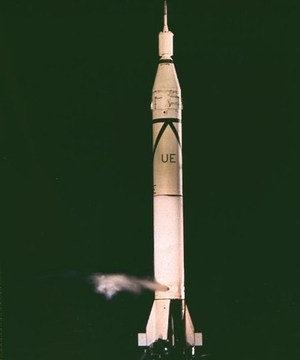
The Redstone-based Jupiter-C (Juno 1) rocket before
it launched Explorer 1 into orbit on January 31, 1958.
(credit: NASA/MSFC)
Jupiter-C Characteristics:
The Jupiter-C rocket was originally developed to test the ablative re-entry nose cone of the Jupiter IRBM, although its satellite-launching capabilities were recognized at the time it was designed.
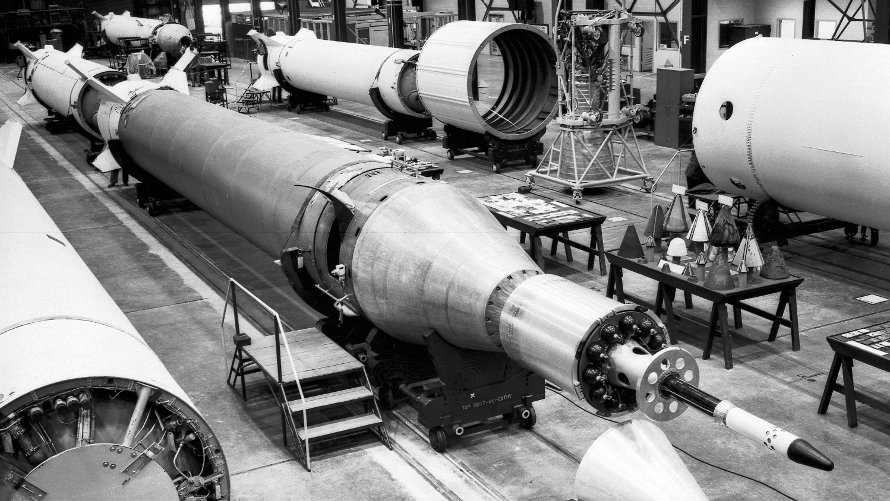
The vehicle consists of a modified Redstone ballistic missile topped by three solid-propellant upper stages. The tankage of the Redstone was lengthened by eight feet to provide additional propellant. The instrument compartment is also smaller and lighter than the Redstone's. The second and third stages are clustered in a "tub" atop the vehicle, while the fourth stage is atop the tub itself. The second stage is an outer ring of eleven scaled-down Sergeant rocket engines; the third stage is a cluster of three scaled down Sergeant rockets grouped within. These are held in position by bulkheads and rings and are surrounded by a cylindrical outer shell. The webbed base plate of the shell rests on a ball-bearing shaft mounted on the first-stage instrument section. Two electric motors spin in the tub at a rate varying from 450 to 750 rpm to compensate for thrust imbalance when the clustered motors fire. The rate of spin is varied by a programmer so that it does not couple with the changing resonant frequency of the first stage during flight.
The upper-stage tub was spun-up before launch. During first-stage flight, the vehicle was guided by a gyro-controleld autopilot controlling both air-vanes and jet vanes on the first stage by means of servos. Following a vertical launch from a simple steel table, the vehicle was programmed so that it was travelling at an angle of 40 degrees from the horizontal at burnout of the first stage, which occurred 157 seconds after launch. At first-stage burnout, explosive bolts fired and springs separated the instrument section from the first-stage tankage. The instrument section and the spinning tub were slowly tipped to a horizontal position by means of four air jets located at the base of the instrument section. When the apex of the vertical flight occurred after a coasting flight of about 247 seconds, a radio signal from the ground ignited the eleven-rocket cluster of the second stage, separating the tub from the instrument section. The third and fourth stages were fired in turn to boost the satellite and fourth stage to an orbital velocity of 18,000 miles per hour.
When used as a satellite launching vehicle, the Jupiter-C is sometimes referred to as the Juno-I.

The satellite was launched from Cape Canaveral (now Cape Kennedy) in Florida at 10:48 P.M. EST on 31 January 1958 by the Jupiter-C vehicle that was designed, built, and launched by the Army Ballistic Missile Agency (ABMA) under the direction of Dr. Wernher Von Braun. Jupiter-C, a direct descendant of the German A-4 (V-2) rocket, was originally developed in 1955-1956 as a high-performance rocket for testing purposes.

Jon Medaris and Wernher Von Braun in the blockhouse at Cape
Canaveral during the count-down firing of the Jupiter C Rocket.
JUPITER-C/JUNO-I
Explorer-1 Launch
________________________________________
Weight (in pounds)--Loaded--Empty
Overall (takeoff)-----64,000--10,260
Stage 1----------------62,700---9,600
Stage 2------------------1,020-----490
Stage 3--------------------280-----140
Stage 4---------------------80-------31.5
Propulsion
Stage 1: Rocketdyne A-7 engine.--
Thrust, 83,000 lb; burning time, 155 seconds; specific impulse, 235 seconds; propellants, liquid oxygen, as oxidizer, and "Hydyne" (60% unsymmetrical, dimethylhydrazine and 40% diethylenetriamine), as fuel; propellant feed, turbopump type; turbopump drive, 90% hydrogen peroxide decomposed by catalyst bed to produce steam.
Stage 2: Eleven JPL scaled-down Sergeant rockets.--
Thrust, 16,500 lb; burning time, 6.5 seconds; specific impulse, 220 lb-sec/lb; propellant, polysulfide-aluminum and ammonium perchlorate (solid propellant).
Stage 3: Three JPL scaled-down Sergeant rockets.--
Thrust, 5,400 lb ; burning time, 6.5 seconds; specific impulse, 235 lb-sec/lb; propellant, same as for Stage 2.
Stage 4: One JPL scaled-down Sergeant rocket.-- (the Explorer-1 satellite) same as for Stage 3.
JUPITER-C Flight History
(three-stage configuration):
20 September 1956: Lofted an 86.5-pound payload to an altitude of 680 miles and a range of 3,300 miles from Cape Canaveral, Florida.
15 May 1957: Lofted an 300-pound scale Jupiter ablative nose cone to an altitude of 350 miles and a range of 710 miles.
8 August 1957: Lofted a 1/3-scale Jupiter nose cone to an altitude of 285 miles and a range of 1,330 miles. JUNO-I
(four-stage configuration).
America's First Satellite - Explorer 1
31 January 1958: Orbited Explorer-I satellite weighing 30.66 pounds with 18.35 pounds of payload, perigee 224 miles, apogee 1,575 miles. Still in orbit (1965).
See: Ludwig, George H. "Cosmic- Ray Instrumentation in the First U.S. Earth Satellite" The Review of Scientific Instruments, Volume 30, Number 4, April 1959.
Other info about the JUPITER-C

This is the satellite that was at the top of the rocket shown below and to the right, the Explorer I.
You can see it sticking out of the top of the tub (or drum) up above on the left photo.
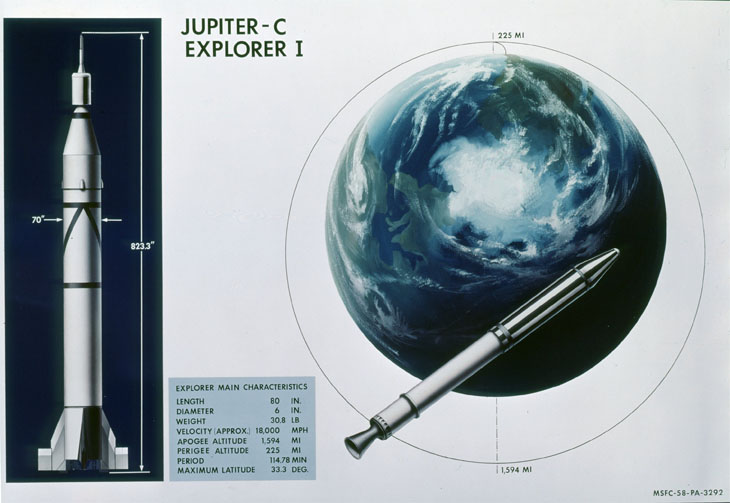
The satellite was supposed to launch as the United States' contribution to science during International Geophysical Year (which ran from 1957-1958). Then history intervened. The Soviet Union rocketed Sputnik into space on Oct. 4, 1957. This was the first artificial satellite any nation sent out of the Earth. The launch — revealed only after it was a success — stunned most of the Western world. It was a coup for Soviet rocket technology, and led some to muse that bombs could be launched just as easily as a satellite.
This accelerated the United States' plans. Rocket and satellite engineers quickly got to work, trying to prove they were also capable of launching into space.
by NASA/JPL
Updated June 28, 2017
The Explorer I satellite

The left is Dr. William H. Pickering, Dr. James
A. van Allen, at right is Dr. Wernher von Braun.
Why was the Jupiter-C also called the Juno I?
The Juno I was a satellite launch vehicle based on the Jupiter-C, but with the addition of a fourth stage, atop the "tub" of the third stage. The Juno name derived from Wernher von Braun wishing to make the satellite launch appear as peaceable as the Vanguard rocket, which was not a weapon, but was developed from a weather study rocket, the Viking. Since the Juno I was the same height as the Jupiter-C (21.2 meters), with the added fourth stage being hidden inside the shell, this vehicle which successfully launched the first orbital satellite of the United States is often incorrectly referred to as a Jupiter-C.

Wernher Magnus Maximilian Freiherr von Braun
(March 23, 1912 – June 16, 1977)
From Mr. von Braun who created the German V2 all the way to the Jupiter-C/Explorer-1 (was already a US citizen) under President John Kennedy in the 60's, was responsible for the Apollo program which brought us to the moon! Wow what an amazing human being.
I hope you enjoyed the history so far, the next post will be the Glencoe model, sprue layouts and the start of the build.
Thank you for stopping by and looking!






 )
)


 )
)