Time for some information on the Panther.
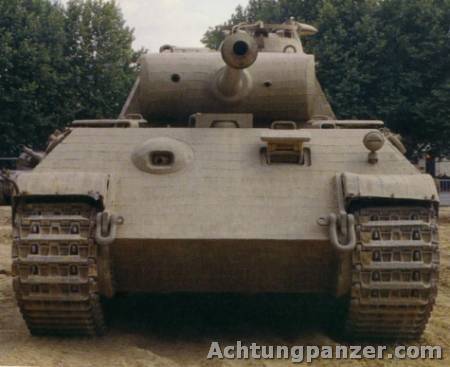
The Panzerkampfwagen V Panther, next to the PzKpfw VI Tiger, is the best-known German tank of World War II. The Panther and the Soviet T-34 (both 76mm and 85mm models) are considered to be the best tanks of World War II and even first main battle tanks (MBT). When in June of 1941, Germany invaded the Soviet Union, Panzertruppe encountered KV (Klimemti Voroschilov) series heavy tanks and T-34/76medium tanks. New Soviet tanks were a shock to the Germans, being far superior in firepower and armor protection to any Panzer at the time, but lacked in communication equipment. At the early stages of the Operation Barbarossa, German troops encountered small groups of KV and T-34 tanks and were able to defeat them due to the general disorganization, inexperience of the Red Army tank commanders and overall poor leadership of the Soviet command due Stalin’s purges. The situation became much more harder for the Germans, once the Red Army deployed more T-34 tanks, reorganized and offered coordinated defence mounting counterattacks. In early November of 1941, because of the constant reports from the front, special Panzerkommission visited Guderian’s 2nd Panzer Army (part of Army Group Centre) on the Eastern Front to inspect captured T-34/76 tanks and to asses what needed to be done. It was decided to design a new more powerful medium tank, which could be quickly put into production. On November 25th of 1941, Adolf Hitler ordered Wa Pruef to start work on the new medium tank that would outperform T-34. In December of 1941, Wa Pruef ordered Daimler-Benz and MAN (Maschinenfabrik Augsburg Nuernberg) to design new 30-ton tank armed with 75mm KwK L/70 gun as a response to theSoviet T-34/76 tank. Rheinmetall-Borsig was in charge of the development of the turret for this new tank. In March of 1942, Daimler-Benz was the first to produce their version of VK3002’s design based on previously rejected VK3001 (direct copy of T-34/76) design from January of 1942. Two versions of VK 3001 with different suspensions were designed by Daimler-Benz – one with spring suspension and other with torsion bar suspension.Daimler-Benz VK3002 design was largely based on T-34/76 and was more like a modified German version of it. MAN finished their design of VK3002, which largely based on examined captured T-34/76 tank, in early Spring of 1942.
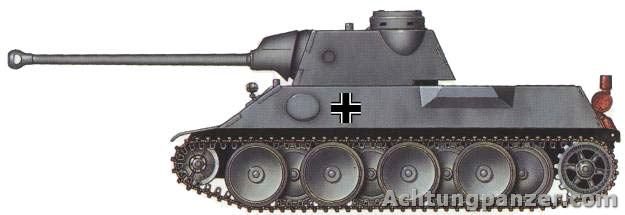
VK3002(DB)’s turret was mounted in the forward position of the hull just like that of T-34/76. Prototype was presented to the Fuehrer, who ordered the production of 200 new tanks to start as soon as possible. On May 11th of 1942, VK3002 project received the designation of Panther. On May 14th of 1942, when extensive tests of both prototypes were completed, Hitler decided to put MAN’s design into production. Daimler-Benz’s design was rejected since it was assumed that it would cause many problems with identification of the vehicle "being too Russian in apperance" and also proved to have poor performance and many modifications would have to be made in order to create reliable tank. It is interesting to note that the Daimler-Benz prototype was captured by the Soviets in May of 1945. Skoda also provided their design similar to Soviet T-34/76, designated Panzerkampfwagen T-25, but its design was also rejected. Skoda’s design was behind in the development stage being still on the drawings board. Interestingly enough, it featured semi-automatic 75mm gun with drum auto loader. In June/July of 1942, MAN’s Panther was finally accepted for full-scale production. Adolf Hitler ordered that the production of MAN’s Panther was to start as early as December of 1942. Adolf Hitler himself insisted on using 75mm KwK 42 L/100 gun, but since the new gun was not ready for production, shorter 75mm KwK 42 L/70 gun was used instead. The main gun was capable of penetrating almost 150mm thick armor at the range of 1000 meters and its penetration capability was slightly better than that of Tiger’s 88mm gun. VK3002(MAN)’s design had its turret mounted in the central part of the hull and had better overall performance.
Panther’s overall design incorporated many features of the T-34/76, such as wide tracks for better traction and improved cross-country performance, a powerful engine (Panther – gasoline vs. T-34 – diesel), a hard-hitting long-barrelled 75mm gun, and sloping armor for extra protection. It is important to note that thePanther was the first German-made tank with sloping and interlocking armor plates. Although its design was in some ways similar to the T-34/76, the Panther was a much more sophisticated and complicated tank, while being larger, heavier, and different in many technical aspects. The Panther had large overlapping road wheels and a state-of-the-art suspension system that enabled it to traverse rough terrain at high speed. Germans understood that the new tank must not only be an equivalent to the T-34, but must be superior to it in terms of performance, armament, armor and overall quality. The quick development of a new and sophisticated medium tank was not without its problems as the new tank was quickly rushed into service with unresolved problems. It was also much different from its predecessor (in name only) – proved medium Panzerkampfwagen IV, which when compared to the Panther being almost twice as heavy was an almost a light tank. Due to worsening situation on all fronts and slow production of the Panther, Panzerkampfwagen IV ultimately remained the backbone of the German Panzertruppen to the end of the war.
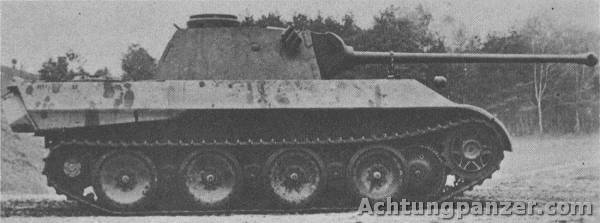
From July to September 1942, MAN produced two prototypes, only one of which was fitted with a turret. These were extensively tested and proved prone to many technical problems. At the same time, a first order for 1,000 tanks was placed, with the first tank expected in early 1943. It is interesting to point out that MAN made arrangement for rear mounted external fuel tanks, but this feature was not carried into production. In late 1942, a small pre-production series of 20 tanks was ordered. This was the Null-Serie, or Zero Series. Those 20 tanks were designated Panzerkampfwagen V Panther Ausfuehrung A and were technically different from later Ausf A production models. All were lightly armored (with 60mm frontal armor) and armed with the early version of the 75mm KwK 42 L/70 gun. This gun had a single-chamber muzzle brake from the 75mm KwK 40 L/43 gun and was mounted in a turret that featured a drum cupola that bulged the turret on the left side. A 650hp Maybach HL 210 P 45 engine of 21 liters (1,280 cubic inches) displacement powered them. Interesting conversion was Ausf D1 (some sources state that it was an early model Bergepanther) fitted with bolted on PzKpfw IV Ausf H’s turret (that could not be traversed), which served as a command tank of schwere Heeres Panzerjager Abteilung 653 on the Eastern Front in early/mid of 1944. The same unit used other early model Bergepanther that was mounted with 20mm Flakvierling anti-aircraft gun and Flakpanzer T-34(r).
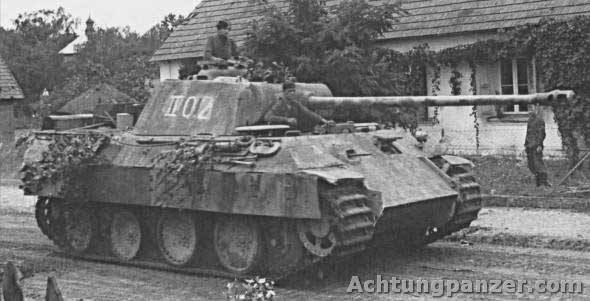
Panzerkampfwagen V Panther Ausf A
from 5th SS Panzer Division "Wiking", Eastern Front.
In August 1943, after repairs and modifications to the gearbox and other systems, a new variant of Panther was produced – the Ausf A, which soon became a formidable weapon. Panther Ausf A was the most numerous variant during the Normandy campaign in the summer of 1944, and some 400 Panthers of all types were lost there. Panther Ausf A featured a redesigned turret, the new cast commander’s cupola, a mounting bracket for an anti-aircraft MG34 on the cupola, a ball-mounted MG34 in the frontal plate and standard side armor skirts. Side skirts and the brackets holding them had to be removed for transport by rail as the width of the Panther reached the maximum clearance for transport by rail. Over time, five different types of exhaust arrangement were used. In general, from August 1943 to May 1944, some 2,200 were produced by MAN, Daimler-Benz, Demag and Henschel.
As with any weapon in constant use, various modifications and design changes were made to the Panther to improve its combat capabilities, while resolving outstanding issues. In March 1944, the first Ausf G was produced. The new Panther was much more reliable than previous models and became the most numerous model, and featured many new features. These included a new design for the top hull hatches, removal of the driver’s visor in the glacis (front) plate and upper hull sides closer to the vertical. Later variants had a rotating periscope for the driver, a new exhaust arrangement, a new gun mantlet with a reinforced "chin" designed to eliminate the shot trap and a new engine deck layout with a raised fan cover.
Perhaps the most distinctive feature of the Ausf G was the tapered one-piece upper hull side plate on the sponson over the suspension. From March 1944 to April 1945, some 2,950 were produced by MAN, Daimler-Benz and MNH. The only issues never resolved were slow turret traverse of 30 seconds (T-34 – 10 seconds and Sherman – 15 seconds) and lack of gunner’s periscope that delayed the engagement time.
Older models returned for repairs were often refitted with newer parts creating hybrids. Vehicles made and rebuild between September of 1943 to August/September of 1944, were factory applied with Zimmerit anti-magnetic paste. Vehicles already deployed had the Zimmerit applied by local repair shops. Vehicles produced from September of 1944, left the factory with partial camouflage paint schemes with red oxide primer showing. Eventually, the interiors of the tanks were no longer painted and remained in primer. As the war situation became even more desperate, tanks were camouflaged with foliage in factories in preparation for transport by rail.
Overall, from 1943 to 1945, only some 6000 (5928 or 6042 depending on the source) Panthers were produced by Maschinenfabrik-Augsburg-Nuremberg (MAN) in Kassel and Maschinenfabrik Niedersachsen-Hannover (MNH) in Hannover, along with Daimler-Benz, Henschel and Demag. At the end, the number of Panthers produced was not enough to counter the number of Allied tanks being produced and supplied to the troops on both Western and Eastern Front.
You can read more about the Panther by visiting this website:
http://www.achtungpanzer.com/panzerkamp ... fz-171.htm
It goes on and on and on and on about the Panther. If you are a history nut and a Panther nut then it should be your cup of tea.


 Very nice job so far.


 That camo


 Not sure.


