Hobby Boss 1/72 Morser KARL-Gerat 040/041 Initial Version
Posted: Sun Nov 16, 2014 7:30 pm
Hello all,
So as I get back into the hobby I am not only finishing up some shelf queens I did not complete, but also starting a new kit. I couldn't resist the temptation!
For this build I am doing the Morser KARL-Gerat in 1/72 scale from Hobby Boss, with a PE set from Eduard. This is my first foray into the PE world, other than grill covers and simply pieces included in kits in the past. Boy this is a whole new world of "fiddly bits". But has been fun so far.
First a little history.
"Karl-Gerät" (040/041) (German literally "Karl-device"), also known as Thor and Mörser Karl, was a World War II German self-propelled siege mortar (Mörser) designed and built by Rheinmetall. It was the largest self-propelled weapon to see service.[1] Its heaviest munition was a 60 cm (24 in) diameter, 2,170 kg (4,780 lb) shell, and the range for its lightest shell of 1,250 kg (2,760 lb) was just over 10 km (6.2 mi). Each gun had to be accompanied by a crane, a heavy transport trailer, and several modified tanks to carry shells.
Seven guns were built, of which six saw combat between 1941 and 1945. It was used in attacking the Soviet fortresses of Brest-Litovsk and Sevastopol, bombarded Polish resistance fighters in Warsaw and participated in the Battle of the Bulge and the attacks against the Remagen Bridgehead. Only one exists today; the others were scrapped after the war.
Oddly enough I found the only remaining one in existence is actually in a museum in Russia. This was the one referred to as Adam.

Look at the size of that shell-

With only a top speed of around 6mph, it was often disassembled into several smaller sections, 6 or 7 total and then shipped via rail to where ever it was needed. The sites had to be preppred ahead of time to level and harden the ground it was to travel on otherwise it was liable through a track.
The 040 which is the variant I am building had shells that weighed between 1700-2100 lbs, depending on if they were the light concrete busting shells or the heavy ones. Nothing about 1700lbs says light to me.
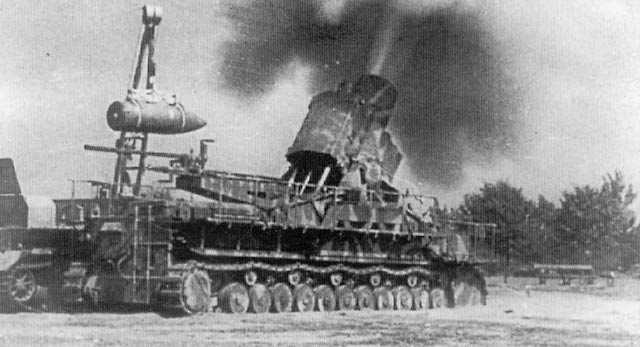
Firing shot.-
Now on to the model -
Obligatory Sprue and Box art -

Springs, decals, and tracks -

Sprues -


Blurry image of the Lower Hull -

Color Guide-

Some work on the kit-
Lower Hull completed.

Upper Hull begun. With some PE. First time really working with PE and i can definitely say it takes patience.....


Both pieces together-

Time to hack away at some pieces -
Before -
Got to seperate this piece at the seem line/joint

During-
Now seperated and the piece i will use is sanded down smooth

AFter-
PE attached. Looks so much nicer than the Photo shows.

Business end -
Picture of the business end of the KARL. With the PE i still have left to include, or at least consider to include on the kit.

Thanks for looking!
So as I get back into the hobby I am not only finishing up some shelf queens I did not complete, but also starting a new kit. I couldn't resist the temptation!
For this build I am doing the Morser KARL-Gerat in 1/72 scale from Hobby Boss, with a PE set from Eduard. This is my first foray into the PE world, other than grill covers and simply pieces included in kits in the past. Boy this is a whole new world of "fiddly bits". But has been fun so far.
First a little history.
"Karl-Gerät" (040/041) (German literally "Karl-device"), also known as Thor and Mörser Karl, was a World War II German self-propelled siege mortar (Mörser) designed and built by Rheinmetall. It was the largest self-propelled weapon to see service.[1] Its heaviest munition was a 60 cm (24 in) diameter, 2,170 kg (4,780 lb) shell, and the range for its lightest shell of 1,250 kg (2,760 lb) was just over 10 km (6.2 mi). Each gun had to be accompanied by a crane, a heavy transport trailer, and several modified tanks to carry shells.
Seven guns were built, of which six saw combat between 1941 and 1945. It was used in attacking the Soviet fortresses of Brest-Litovsk and Sevastopol, bombarded Polish resistance fighters in Warsaw and participated in the Battle of the Bulge and the attacks against the Remagen Bridgehead. Only one exists today; the others were scrapped after the war.
Oddly enough I found the only remaining one in existence is actually in a museum in Russia. This was the one referred to as Adam.
Look at the size of that shell-
With only a top speed of around 6mph, it was often disassembled into several smaller sections, 6 or 7 total and then shipped via rail to where ever it was needed. The sites had to be preppred ahead of time to level and harden the ground it was to travel on otherwise it was liable through a track.
The 040 which is the variant I am building had shells that weighed between 1700-2100 lbs, depending on if they were the light concrete busting shells or the heavy ones. Nothing about 1700lbs says light to me.
Firing shot.-
Now on to the model -
Obligatory Sprue and Box art -

Springs, decals, and tracks -

Sprues -


Blurry image of the Lower Hull -

Color Guide-

Some work on the kit-
Lower Hull completed.

Upper Hull begun. With some PE. First time really working with PE and i can definitely say it takes patience.....


Both pieces together-

Time to hack away at some pieces -
Before -
Got to seperate this piece at the seem line/joint

During-
Now seperated and the piece i will use is sanded down smooth

AFter-
PE attached. Looks so much nicer than the Photo shows.

Business end -
Picture of the business end of the KARL. With the PE i still have left to include, or at least consider to include on the kit.

Thanks for looking!
 . Good choice of Firm better like Hasegawa. Good work at this stage
  ...My finished Karl:

